
Posted by: Eye Health Northwest in Eyelid Surgery on April 16, 2026
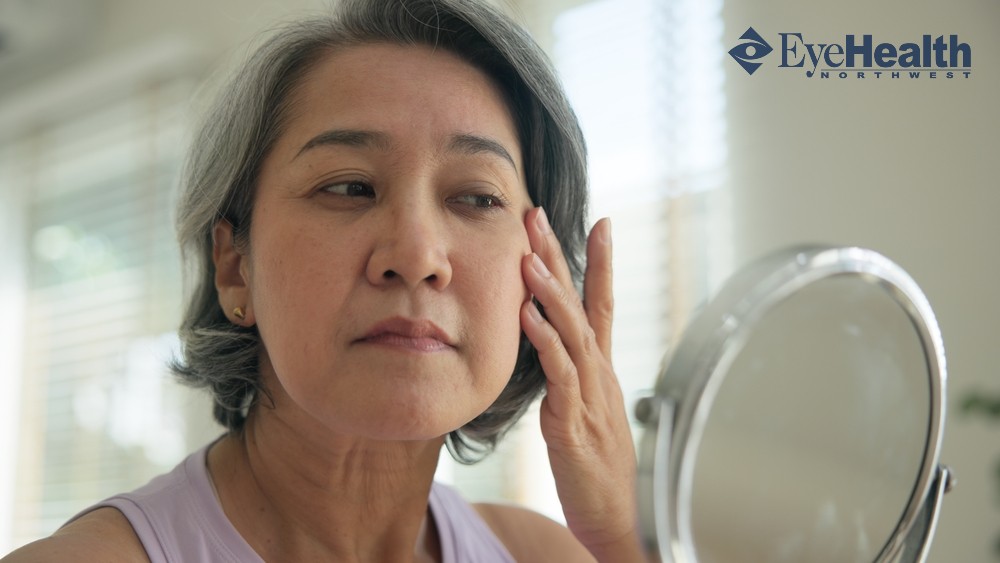
Looking in the mirror and noticing your eyelids seem heavier than they used to be? Maybe your upper lids are starting to block part of your vision, or the skin around your eyes just doesn’t look the way it once did.
Drooping eyelids are among the most common reasons patients visit an oculoplastic surgeon, but not every case has the same root cause. Keep reading to learn about two different conditions that can lead to drooping eyelids and the treatments your eye doctor can use to correct them.
Two Causes of Drooping Eyelids: Ptosis vs. Dermatochalasis
When patients come in with drooping eyelids, the first step is figuring out what’s actually causing it. There are two primary culprits: ptosis and dermatochalasis.
Ptosis occurs when the levator muscle, the small muscle responsible for lifting your upper eyelid, weakens or separates from its attachment. When this happens, the lid droops down over the eye. Some people are born with ptosis, while others develop it gradually with age. It can affect one eye or both, and in more severe cases, it can block a significant portion of your visual field.
Dermatochalasis is different; rather than a muscle problem, it involves excess skin that has stretched and lost its elasticity over time. Fat may also bulge forward, creating a heavy, hooded appearance.
Aging, genetics, and sun exposure all contribute. When the excess skin becomes severe enough, it can hang over the lashes and limit peripheral vision, similar to ptosis but for entirely different reasons.
Both conditions can make you look tired and older than you feel, and both can interfere with your sight. However, because they stem from different causes, each one requires a unique surgical approach.
How Is Ptosis Treated?
Because ptosis involves a weakened or displaced muscle, treating it involves addressing that muscle directly. The procedure is called a ptosis repair, and it focuses on tightening or reattaching the levator muscle to lift the eyelid back to its normal position.
Your eye doctor can perform ptosis repair through an incision in the skin of your upper eyelid or from underneath the lid, depending on the technique that best suits your anatomy. Both approaches are done on an outpatient basis using local anesthesia with sedation, so you remain comfortable throughout the procedure.
For some adults with mild acquired ptosis, a prescription eye drop called oxymetazoline may offer temporary improvement by stimulating the levator muscle. These drops need to be used daily and don’t work for every type of ptosis, so a conversation with your ophthalmologist is the best place to start.
How Is Dermatochalasis Treated?
When drooping eyelids are caused by dermatochalasis rather than a muscle issue, the preferred treatment is often blepharoplasty. This procedure removes excess skin and repositions or removes protruding fat to restore a more open, refreshed appearance.
For the upper eyelids, your surgeon makes a small incision along the natural crease, so any scarring is virtually invisible once healed. The procedure takes about 30 minutes and can be performed in an outpatient facility or even in the office under local anesthesia. Upper blepharoplasty may be covered by insurance when the excess skin is severe enough to obstruct vision.
Lower blepharoplasty targets puffy bags beneath the eyes. Because the incision is often made inside the lower eyelid, it is typically a scarless procedure. Bruising from either procedure generally fades within one to three weeks, and most patients feel comfortable returning to their regular routine relatively quickly.
Clearer Vision Starts With a Comprehensive Evaluation
The best treatment for droopy eyelids depends entirely on what’s causing the problem. A thorough evaluation by an oculoplastic surgeon can determine whether you need ptosis repair, blepharoplasty, or a combination of both.
If heavy or sagging eyelids are affecting your vision or how you feel about your appearance, schedule an appointment at EyeHealth Northwest in Portland, OR, to explore your options today.